Three things
It’s a good idea to report three main things in an APA style results section when it comes to t-tests. Doing so will help your reader more fully understand your results.
1. Test type and use
You want to tell your reader what type of analysis you conducted. If you don’t, your results won’t make much sense to the reader. You also want to tell your reader why this particular analysis was used. What did your analysis tests for? Example
You can report data from your own experiments by using the template below.
“An independent-samples t-test was conducted to compare (your DV measure) _________ in (IV level / condition 1) ________and (IV level / condition 2)________ conditions.”
If we were reporting data for our example, we might write a sentence like this.
“An independent-samples t-test was conducted to compare memory for words in sugar and no sugar conditions.”
2. Significant differences between conditions
You want to tell your reader whether or not there was a significant difference between condition means. You can report data from your own experiments by using the template below.
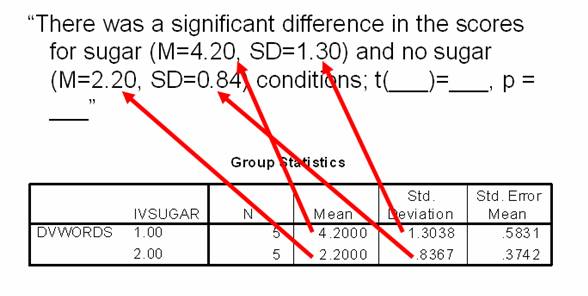
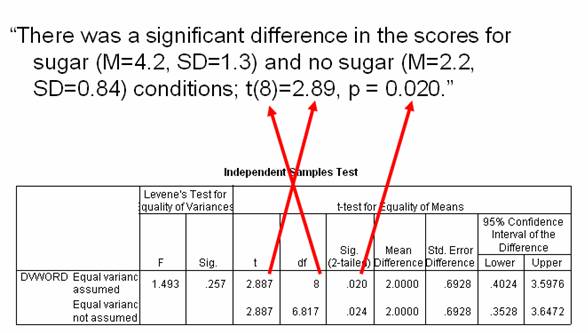
“There was a significant (not a significant) difference in the scores for IV level 1 (M=___, SD=___) and IV level 2 (M=___, SD=___) conditions; t(__)=____, p = ____”
Just fill in the blanks by using the SPSS output
Let’s start by filing in the Mean and Standard Deviation for each condition.
Now we’ll finish up by filling in the values related to the T-Test. Here we enter the degrees of freedom (df), the t-value (t), and the Sig. (2-tailed) value (often referred to as the p value).
Once the blanks are full…
You have a sentence that looks very scientific but was actually very simple to produce.
“There was a significant difference in the scores for sugar (M=4.2, SD=1.3) and no sugar (M=2.2, SD=0.84) conditions; t (8)=2.89, p = 0.020.”
3. Report your results in words that people can understand
You have to admit, the previous sentence is pretty intimidating. It might be hard for someone to figure out what that sentence means or how it relates to your experiment. That’s why it’s a good idea to report you results in an easy to understand language, after you have stated them scientifically. Imagine that you were trying to explain these results to a family member or friend who does not know much about science.
Example
You might write something like this for our example.
“These results suggest that sugar really does have an effect on memory for words. Specifically, our results suggest that when humans consume sugar, they remember more words.”
This sentence is so much easier to understand than the one will all of the numbers in it.
All together now
When you put the three main components together, results look something like this.
“An independent-samples t-test was conducted to compare memory for words in sugar and no sugar conditions. There was a significant difference in the scores for sugar (M=4.2, SD=1.3) and no sugar (M=2.2, SD=0.84) conditions; t (8)=2.89, p = 0.20. These results suggest that sugar really does have an effect on memory for words. Specifically, our results suggest that when humans consume sugar, their memory for words increases.”
Looks pretty good huh? This isn’t so
hard after all.
Background |
Enter Data |
Analyze Data |
Interpret Data |
Report Data
|